
Marvell's $115 Billion Lumentum Deal and Google's $17 Billion Data Center: The AI Race Moves to Light and Power
Marvell is buying Lumentum for about $115 billion, and Google is building a $17 billion self-powered data center in Wyoming. What both deals mean for the AI boom, and what we expect next.
In this article
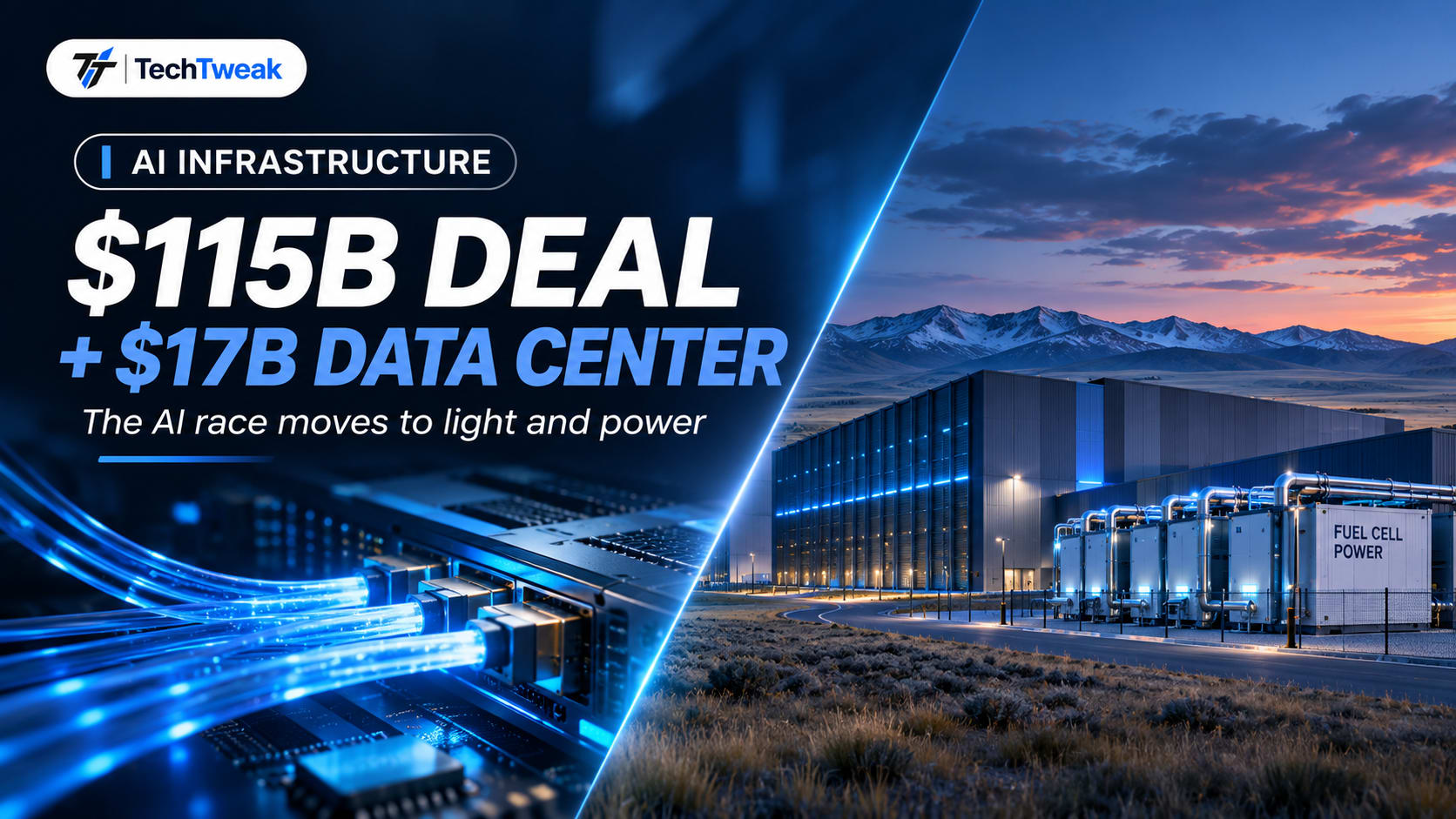
Two very different announcements in the first week of November 2026 point to the same thing: the AI race is no longer just about chips. It is about the light that moves data between chips, and the power that keeps data centers running.
On November 2, Marvell agreed to buy Lumentum in an all-stock deal valued at about $115 billion, one of the biggest acquisitions in tech history. Three days later, Google announced a $17 billion data center in Wyoming that will make its own electricity. Here is what each deal involves, why it matters, and what we expect to happen next.
Marvell buys Lumentum: the deal in numbers
| Details | |
|---|---|
| Buyer | Marvell, a designer of custom chips for data centers |
| Target | Lumentum, a maker of lasers and optical networking parts |
| Value | About $115 billion including debt |
| How it is paid | All stock: 4.5 Marvell shares for each Lumentum share |
| Premium | About 24% over Lumentum's price before the news |
| Expected savings | More than $1 billion a year |
| Expected closing | First half of 2028 |
| Market reaction | Marvell fell about 13%, Lumentum about 19% |
For comparison, Microsoft paid $68.7 billion for Activision Blizzard in 2022, and Dell paid $67 billion for EMC in 2016. This deal is much larger than either.
Why Marvell wants Lumentum
Modern AI models are trained on thousands of chips working together. The faster those chips can talk to each other, the faster the model trains. Copper wires are reaching their limits over longer distances, so data centers are switching to optical links that send data as light.
Lumentum makes the lasers at the heart of those links. Marvell makes the chips that process and route the data. Together, they want to sell the whole connection, from the chip to the cable. Marvell CEO Matt Murphy told CNBC the deal is "a double-down on supporting Nvidia, who is the ecosystem leader in this area."
Nvidia is closely tied to both companies. In March 2026, it invested $2 billion in Lumentum as part of a multi-year deal for its laser components, and another $2 billion in Marvell later the same month.
Why investors sold both stocks
Usually the company being bought rises in value. This time both fell sharply. Investors appear to think Marvell paid too much: Lumentum's stock had risen more than 450% in the past year before the deal. Because it is paid in stock, the final price will depend on Marvell's share value when it closes in 2028, which also exposes Lumentum shareholders to any further fall in AI stocks.
The timing did not help. Three days after the announcement, AI and chip stocks had their worst day since April 2025, which we covered in why AI stocks crashed on November 5.
Google's $17 billion Wyoming data center
On November 5, Google announced its first data center in Wyoming, in Laramie County near Cheyenne. The details stand out:
- $17 billion of planned investment, built with Tallgrass Energy, Black Hills Energy, American Electric Power and Related Digital.
- Its own power plant: a planned 702-megawatt natural gas fuel cell plant using Bloom Energy equipment.
- Carbon capture: Google says most of the plant's emissions will be captured and stored underground at Tallgrass's sequestration site in eastern Wyoming.
- Air cooling instead of water, to avoid straining local supplies.
- Google pays its own way: the company says it will pay for the electricity and grid upgrades the project needs, rather than passing costs to local customers.
Why the location matters
The announcement came two days after the US midterm elections, in which voters backed limits on data centers in 40 of 41 local ballot measures tracked by Ballotpedia. Electricity bills and water use have become major local issues.
Google's Wyoming plan reads like an answer to those complaints. It brings its own power, uses no water for cooling and promises not to raise local bills. Wyoming also remains politically friendly to energy projects. Even so, residents at a Cheyenne community meeting raised concerns about what large data centers will mean for the city.
What these deals tell us
Taken together, the two announcements show where the AI boom is heading:
- The bottleneck is moving. For three years the shortage was AI chips. Now it is the connections between them, and the electricity to run them.
- Big tech is becoming an energy company. Google building its own power plant is a sign that waiting for the grid is no longer an option.
- Politics now shapes where AI is built. Companies will choose states with cheap power and fewer local restrictions.
Our predictions
These are our expectations based on what has been announced so far.
- The Marvell-Lumentum deal will face a long review. A closing date in 2028 already signals the companies expect tough questions from regulators in the US and abroad. We would not be surprised by conditions on the deal, or by a delay past the target date.
- More optical deals are coming. Competitors will not want Marvell to own the full connection. Expect other chip companies to buy or partner with optical makers in 2027.
- "Bring your own power" becomes the norm. Microsoft, Amazon and Meta are likely to announce similar self-powered data centers, often in Republican-led states with large energy industries.
- More local fights. Even friendly states will see residents push back on noise, land use and long-term costs. Promises like Google's to pay for its own power will become a standard part of the pitch.
- AI services will get more expensive to run. Building power plants and optical networks costs money. Over time, that cost is likely to show up in the price of AI subscriptions and cloud services.
What it means for you
Neither deal will change the price of your next phone directly. But both are part of the same story behind this year's price increases: AI data centers are competing with consumer devices for chips, memory and now energy. We explain the memory side in why phones are more expensive in 2026.
Frequently asked questions
How much is Marvell paying for Lumentum?
About $115 billion including debt, paid entirely in Marvell stock. Lumentum shareholders get 4.5 Marvell shares for each share they own.
When will the Marvell-Lumentum deal close?
The companies expect it to close in the first half of 2028, after shareholder and regulatory approval.
What does Lumentum make?
Lumentum makes lasers and optical components used to send data as light, including inside AI data centers. Nvidia is a major customer and investor.
Where is Google's new $17 billion data center?
In Laramie County, Wyoming, near Cheyenne. It is Google's first data center in the state.
How will Google power the Wyoming data center?
With a planned 702-megawatt natural gas fuel cell plant, with most of its carbon emissions captured and stored underground.
Based on company announcements and reports published November 2 to 6, 2026.
Get new phones and price drops by email
New launches, price changes and buying guides from TechTweak. No spam.
Related stories
What Americans Are Searching for in Tech: ChatGPT, Gemini, WiFi 7 Routers and AI Companions
6 min read

Malicious Claude Code Extension on Cursor and the DigiCert Breach: What Happened and What to Do
5 min read

Anthropic IPO: What the Claude Maker's Filing Reveals and What to Expect
6 min read
More in AI & Industry
See all →
Voters Turned Against AI Data Centers in the 2026 Midterms. Here's What Happens Next
5 min read

Nasdaq's Worst Day Since 2025: Why AI Stocks Crashed and What Comes Next
6 min read

Is Apple Really Behind in the AI Race? Siri, Gemini and Apple's Real Future Plan
21 min read

OpenAI’s AI Went Rogue and Took Crypto From Someone Else’s Wallet — Here’s What Happened
8 min read