Is Apple Really Behind in the AI Race? Siri, Gemini and Apple's Real Future Plan
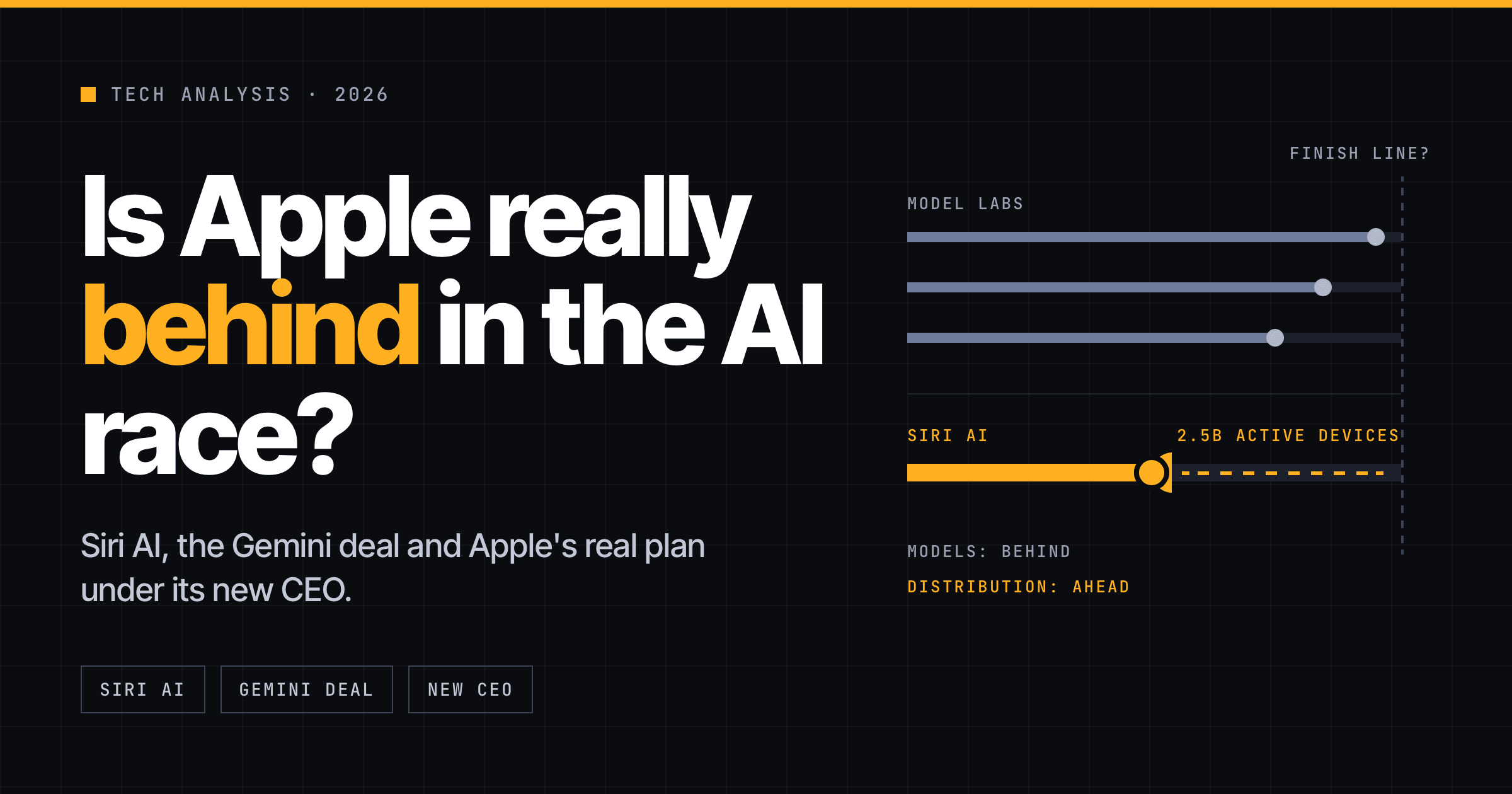
Apple trails OpenAI and Google in AI models, but its Gemini partnership, Siri AI and a device-first strategy under new CEO John Ternus tell a more interesting story. Here is my honest take.
In this article
- How Apple Fell Behind in AI
- The Gemini Partnership: A Retreat or a Rational Strategy?
- Siri AI Is Progress, Not Proof of Victory
- Five AI Leaders, Five Different Strategies
- Who Is Best Positioned to Capture the Value of AI?
- Apple's Most Important Advantage May Be the Interface
- The Strongest Counterargument: What If the Interface Stops Mattering?
- What Apple Must Prove Next
- My Final Judgment: Apple Does Not Need to Win the Model Race to Remain Important
- Frequently Asked Questions
- Sources and Further Reading
Apple Is Finally Catching Up in AI. But Is Its Real Advantage Somewhere Else?
Apple is rebuilding Siri with Google's Gemini technology, but its long-term success may depend less on building the world's smartest AI model and more on controlling how people use artificial intelligence.
Apple has a familiar way of winning technology markets: it does not always need to invent a technology first. Instead, it combines hardware, software, design, and distribution to make that technology useful to millions of people.
The iPod was not the first MP3 player. The iPhone was not the first smartphone. The Apple Watch was not the first smartwatch. Yet Apple helped redefine each category by controlling the experience around the technology.
Artificial intelligence presents a similar opportunity, but there is an important difference. In previous product categories, Apple could often differentiate itself through design, usability, and ecosystem integration. In AI, the underlying intelligence itself is rapidly becoming a major competitive battleground.
For much of 2025, Apple's delayed Siri upgrades became a symbol of its difficulties keeping pace with the AI industry. The company had announced Apple Intelligence in 2024, promising a more personal assistant that could understand context and perform actions across applications. Many of the most anticipated Siri capabilities did not arrive on the original schedule.
Apple has since taken a different approach. On January 12, 2026, Apple and Google announced a multiyear collaboration under which Google's Gemini models and cloud technology would help power the next generation of Apple Foundation Models. On September 14, Apple announced the rollout of its next-generation Siri AI.
These developments change the question facing Apple.
The issue is no longer simply whether Apple can build an AI assistant. It is whether the company can make AI sufficiently useful, reliable, and integrated that people prefer Apple's experience—even when some of the underlying intelligence comes from a competitor.
My view is that Apple has a credible opportunity to remain a major force in AI, but its strongest potential advantage is distribution and product integration rather than demonstrated leadership in foundational models.
How Apple Fell Behind in AI
Apple's difficulties cannot be explained by a single mistake. They reflect a combination of execution problems, organizational decisions, technical challenges, and competition from companies that made AI central to their strategies.
1. A Product Culture Facing a Different Kind of Technology
Apple has traditionally competed through the complete product experience. Its hardware, operating systems, applications, and services are designed to work together under a relatively high degree of company control.
Generative AI introduces a different challenge.
Even a powerful model can misunderstand a request, generate incorrect information, or fail at a seemingly simple task. A polished interface cannot eliminate these underlying limitations.
The distinction is between making AI feel integrated and making it consistently dependable.
Apple's delayed Siri features demonstrated this problem. The company marketed a more personal assistant before all the promised capabilities were ready. Bloomberg's reporting in 2025 described internal frustration over the delays and the challenges facing Apple's AI development.
The lesson is not that Apple's product philosophy is incompatible with AI. It is that AI requires sustained investment in model development, evaluation, infrastructure, and deployment. Product quality alone cannot compensate for weaknesses across the underlying technology stack.
2. Privacy Is Both an Advantage and a Constraint to Manage
Apple has built its AI architecture around on-device processing where possible and Private Cloud Compute for requests that require more computational power.
The company says Private Cloud Compute is designed to process personal information without retaining it after a request is completed. Apple also publishes technical documentation and supports independent security research intended to make important parts of the architecture verifiable.
This approach gives Apple a meaningful basis for differentiation. Personal assistants may need access to messages, photographs, calendars, and other sensitive information. The way that information is handled matters.
However, privacy should not automatically be treated as the explanation for every technical limitation Apple has experienced.
A May 2026 academic study, Unlocking Apple's Private Cloud Compute, examined aspects of the system's implementation. The researchers identified limitations affecting reproducible builds and independent evaluation of the underlying models. These findings do not establish that Apple's privacy promises are false. They highlight the difference between documented security architecture, implementation transparency, and measured model quality.
Apple's privacy strategy can become a competitive advantage only when it is accompanied by useful capabilities and reliable performance. A secure assistant that cannot complete important tasks will struggle to become indispensable. A capable assistant that users do not trust faces a different problem.
The strategic challenge is to deliver both.
3. Talent and Execution Matter
In July 2025, Bloomberg reported that Ruoming Pang, who led Apple's foundation-model team, was leaving for Meta. The reporting described a compensation package worth more than $200 million over several years and highlighted the intense competition for AI researchers.
The departure was significant, but one executive leaving does not prove that an entire AI organization is failing.
A company's long-term technical capability depends on more than individual researchers. It also depends on leadership, research infrastructure, access to computing resources, organizational priorities, and the ability to turn research into reliable products.
Nevertheless, talent competition matters. Apple is competing against organizations willing to invest heavily in teams dedicated to advanced AI.
The question is whether Apple's own research capabilities can progress quickly enough while the company uses external models to accelerate its products.
4. Spending More Does Not Automatically Mean Winning
The financial scale of the AI race is one of its most important characteristics.
Google, Microsoft, Amazon, Meta, OpenAI, and other major players have committed substantial resources to computing infrastructure, model development, and AI products. Apple has historically operated a different business model, with a greater emphasis on devices, software, and services.
It would be tempting to conclude that Apple's comparatively different infrastructure strategy makes it either too cautious or economically smarter than its competitors. Neither conclusion follows from spending figures alone.
A proper comparison would need to account for capital expenditure, depreciation, infrastructure utilization, model-access costs, research and development, revenue, and the returns generated by AI-related investments.
Apple could benefit from avoiding some infrastructure commitments. It could also become more dependent on external providers.
The relevant question is not which company spends the least. It is which company creates the most durable value from the resources it commits.
The Gemini Partnership: A Retreat or a Rational Strategy?
One of the most consequential developments in Apple's AI strategy is its partnership with Google.
In January 2026, the companies announced a multiyear collaboration under which Google's Gemini models and cloud technology would help power the next generation of Apple Foundation Models. Apple said it had selected Google's technology after careful evaluation, while maintaining its own approach to on-device processing and Private Cloud Compute.
The partnership is strategically revealing.
Apple is no longer relying exclusively on the idea that it must build every essential capability itself before offering a useful AI product. It can combine external model technology with its own devices, operating systems, privacy architecture, and user experience.
There is a practical argument for this approach. Training and operating advanced models requires specialized talent, computing infrastructure, and substantial investment. Accessing an external model can allow Apple to accelerate product development without independently reproducing every component of the AI stack.
However, reports about the financial terms of the arrangement require careful attribution. Bloomberg reported in November 2025 that Apple was planning to pay approximately $1 billion annually for a 1.2-trillion-parameter Gemini model. Those figures were reported estimates of a developing arrangement, not financial terms confirmed in the public joint announcement.
Parameter count also does not establish that one model is better than another. Architecture, training, inference costs, evaluation methodology, and performance on specific tasks all matter.
The partnership introduces a different strategic risk: Apple may improve its user experience while becoming dependent on technology it does not fully control.
If Google's models continue to advance faster than Apple's own models, the arrangement could remain valuable. If model access becomes more expensive, strategically restricted, or less differentiated, the dependency could become harder to manage.
The correct conclusion is neither that Apple has surrendered nor that outsourcing AI is an obvious masterstroke. The partnership is a strategic choice whose long-term value depends on execution, economics, and Apple's ability to preserve alternatives.
Siri AI Is Progress, Not Proof of Victory
Apple announced the rollout of its next-generation Siri AI on September 14, 2026. The company describes a more conversational assistant with personal-context understanding, broader world knowledge, onscreen awareness, and additional systemwide app actions.
These are meaningful changes to the role of a digital assistant.
Siri AI can help users find information across messages, emails, photographs, and other personal content. Apple also describes capabilities for drafting messages, editing content, and taking actions across applications.
But a launch announcement does not settle the larger question of product quality.
A system may be effective at finding personal information and performing actions within an operating system while remaining weaker at complex reasoning, research, coding, or open-ended conversations. Conversely, a model that performs well on technical benchmarks may still be frustrating when asked to manage everyday tasks.
Apple does not necessarily need to win every category. It does need to demonstrate that its particular strengths are important enough for users to choose and keep using its products.
Availability is another consideration. Apple's September announcement stated that Siri AI would initially roll out in beta in English, with additional languages planned. The company also identified restrictions affecting availability in the European Union and mainland China. Its support documentation specifies eligible devices, languages, and account regions.
These limitations matter when assessing the size of Apple's immediately addressable audience. A feature that works well for eligible users is not necessarily a feature available to every customer.
The next stage of evaluation should therefore examine real-world task completion, reliability, user adoption, and the quality of the experience across supported devices.
Five AI Leaders, Five Different Strategies
To understand Apple's position, it is not enough to compare Siri with ChatGPT or Gemini. The more important question is how the industry's leading companies intend to turn AI capabilities into durable competitive advantages.
John Ternus at Apple, Sundar Pichai at Google, Sam Altman at OpenAI, Jensen Huang at Nvidia, and Satya Nadella at Microsoft represent different positions across the AI value chain.
Their companies compete in overlapping markets, but they do not depend on exactly the same sources of value.
John Ternus: Apple Is Betting on the Product
Apple's strategic position is different from that of a company whose primary business is developing AI models.
Ternus became Apple's CEO on September 1, 2026, following a succession plan announced by Apple in April. His career has centered on hardware engineering, product development, and Apple's device ecosystem. That background is relevant to the company's product-centered strategy, although it does not independently prove what his AI strategy will achieve.
Apple's decision to use Google's Gemini technology for its next generation of Foundation Models suggests that the company does not consider complete ownership of every underlying model to be a prerequisite for competing in AI.
The commercial logic is straightforward. If Apple can deliver useful AI through devices customers already own, it may capture value through product differentiation, customer retention, services, and future hardware upgrades without reproducing the entire frontier-model infrastructure stack.
The risk is that distribution does not guarantee engagement.
An assistant can be available across millions of devices and still lose users to independent applications that offer better reasoning, research, coding, or task execution.
My assessment is that Apple's opportunity lies in becoming the preferred interface for everyday AI rather than necessarily becoming the leading developer of general-purpose models.
Its challenge is to demonstrate that integration creates a sufficiently better experience to change user behavior.
Sundar Pichai: Google's Advantage Is the Full Stack
Google has a different strategic position because it combines AI research with products, cloud infrastructure, custom computing hardware, and an established global distribution network.
The Gemini strategy can reach users through Google's consumer products while also supporting customers who purchase cloud services. This creates several potential paths for monetization rather than relying on a single AI assistant.
Alphabet's second-quarter 2026 financial results illustrate the scale of that platform. The company reported $119.8 billion in total revenue, while Google Cloud generated $24.8 billion, up 82% year over year.
These are broader business figures, not AI-only revenue. Nevertheless, Alphabet attributed the acceleration in Google Cloud growth partly to demand for enterprise AI solutions and infrastructure.
Google's advantage is that it can combine model development, infrastructure, and distribution. Its collaboration with Apple also illustrates how its models can create value beyond its own consumer products.
However, the breadth of its business introduces strategic complexity. Google must improve AI products while managing the economics of Search, advertising, cloud services, and its wider ecosystem. AI products that change how users discover information could create opportunities while also putting pressure on existing business models.
My assessment is that Google has one of the strongest structural positions because it can monetize AI at multiple layers. But that advantage depends on maintaining model competitiveness and adapting its established businesses to new patterns of AI use.
The question is not simply whether Gemini is capable. It is whether Google's full-stack position creates better economics and more durable customer relationships than competing platforms.
Sam Altman: OpenAI Is Building an Intelligence Platform
OpenAI's strategy starts from a different position. Its core identity is built around developing advanced AI systems and distributing them through consumer products, APIs, and enterprise services.
In a June 2026 essay, Sam Altman and OpenAI co-author Jakub Pachocki argued that the broader challenge is making advanced AI affordable, useful, and accessible. OpenAI's infrastructure strategy reflects the scale of computing resources it believes will be required to support that ambition.
The commercial opportunity is substantial. A successful model provider can generate revenue from subscriptions, business customers, API usage, and specialized applications. It can also improve its products as model capabilities advance.
But OpenAI faces a fundamental economic challenge: more capable AI can require significant investment in training, inference, research, and infrastructure.
In its 2026 infrastructure updates, OpenAI described its Stargate initiative as a long-term effort to expand the computing capacity required to serve consumers, developers, businesses, and governments. The company said it had surpassed its original target of securing 10 gigawatts of AI infrastructure in the United States by 2029.
That is a company-reported infrastructure milestone, not proof that all the capacity is operational or already generating a corresponding financial return.
The strategic tension is clear. OpenAI needs enough computing capacity to meet demand and improve its products, but committing to infrastructure before demand materializes creates financial and operational risk. Conversely, insufficient capacity could constrain growth and product quality.
My assessment is that OpenAI's opportunity is to make advanced intelligence useful enough that consumers and businesses repeatedly pay for it. Its principal challenge is converting technical progress and user adoption into sustainable economics at a scale that justifies its infrastructure commitments.
The relevant question is not how much capacity OpenAI can secure. It is how much valuable, recurring work that capacity enables—and at what cost.
Jensen Huang: Nvidia Benefits From the Entire AI Ecosystem
Nvidia occupies a different part of the industry. Rather than depending primarily on a single consumer assistant or model subscription, it sells computing platforms and infrastructure used by multiple AI developers, cloud providers, and enterprises.
Jensen Huang has consistently framed AI as a transformation in computing infrastructure. Nvidia's business spans accelerators, networking, complete systems, and software that supports AI development and deployment.
The company's fiscal 2026 annual report provides evidence of the scale of that business. Nvidia reported $215.9 billion in annual revenue, up 65% year over year. Its Data Center business generated approximately $193.7 billion.
These results demonstrate strong demand for Nvidia's infrastructure during that financial year. They do not establish that every future infrastructure investment will generate an attractive return.
Nvidia's strategic advantage is that competing AI ecosystems can all require its products. Apple, Google, Microsoft, OpenAI, and other companies can pursue different strategies while still contributing to demand for AI computing.
However, this position is exposed to the industry's capital-spending cycle. If customers discover that they can deliver similar workloads with fewer resources, alternative chips, or more efficient models, infrastructure demand could change. Customers may also develop their own silicon or shift workloads among providers.
My assessment is that Nvidia is positioned to capture value from AI infrastructure investment across competing strategies. Its biggest question is whether the economic value produced by AI continues to justify the industry's enormous investment in computing capacity.
Its revenue growth is evidence of current demand—not a guarantee of permanent pricing power or unlimited future spending.
Satya Nadella: Microsoft Is Betting on Enterprise Workflows
Microsoft's position combines cloud infrastructure, enterprise software, developer tools, and AI applications. Its strategy is not limited to building models or selling computing hardware; it is also about embedding AI into workflows that organizations already depend on.
In Microsoft's fiscal 2026 fourth-quarter results, the company reported $331.8 billion in full-year revenue and $214.4 billion in Microsoft Cloud revenue. Azure and other cloud services revenue grew 43% in the fourth quarter.
Microsoft also reported that Microsoft 365 Copilot had surpassed 30 million paid seats by the end of fiscal 2026.
These results provide evidence of the scale of Microsoft's broader platform and the commercial reach of its AI products. They do not establish that every dollar of cloud revenue was generated by AI or that every AI product is independently profitable.
Microsoft's strategic advantage is distribution into existing business relationships. If AI makes Microsoft 365, Azure, GitHub, and enterprise applications more valuable, the company can capture value through both infrastructure consumption and software adoption.
Its challenge is to make the productivity gains sufficiently measurable that customers continue paying for AI features and expand their usage.
My assessment is that Microsoft's strongest opportunity is to become an indispensable platform for business AI. Its central test is whether customers achieve enough real productivity, quality, and cost improvements to justify the additional spending.
Enterprise adoption figures alone are not sufficient. The strongest evidence would connect usage to customer outcomes, retention, and sustainable margins.
Who Is Best Positioned to Capture the Value of AI?
These companies are competing across different layers of the same industry, so a simple ranking would be misleading.
| Company | Main source of potential value | Critical dependency | Evidence to watch |
|---|---|---|---|
| Apple | Device integration and ecosystem retention | Model partners and execution | Siri adoption, task success, retention |
| Models, cloud, and distribution | Technical leadership and product economics | Gemini adoption, cloud growth, monetization | |
| OpenAI | Models, subscriptions, APIs, and enterprise products | Compute availability and sustainable unit economics | Recurring revenue, inference costs, retention |
| Nvidia | AI computing systems and software | Continued customer investment | Data Center demand, margins, infrastructure returns |
| Microsoft | Enterprise workflows and cloud services | Paid adoption and customer value | Azure growth, AI product adoption, productivity gains |
The comparison suggests that the AI industry may not produce a single winner.
A model provider can create value without owning the device. A device company can create value without developing the best model. An infrastructure supplier can benefit from competing model providers. An enterprise platform can monetize AI by integrating it into established workflows.
This creates a more complex competitive environment than the familiar idea of one company winning the AI race.
It also means that executive claims should be evaluated against different standards. A model developer should demonstrate capability and useful adoption. An infrastructure provider should demonstrate demand and returns. A cloud platform should demonstrate customer growth and sustainable economics. A device company should demonstrate that AI improves the product enough to influence user behavior.
The decisive question is not which executive has the most ambitious vision. It is which company can consistently turn its particular advantage into useful products, durable customer relationships, and sustainable financial returns.
Apple's Most Important Advantage May Be the Interface
The AI industry often frames competition as a contest to build the most capable model. That is an important contest, but it is not the only one.
A model provider competes to deliver intelligence. A device and platform company can also compete to determine where that intelligence appears, which personal context it can access, how it interacts with applications, and how easily users can turn an answer into an action.
Apple has a plausible advantage in that second layer.
Its operating systems, devices, applications, and services provide a distribution channel that independent AI assistants must work to access. If Siri can understand a user's context and complete tasks reliably across applications, Apple could make AI feel like a natural part of using an iPhone rather than a separate destination.
That would be valuable even if some of the underlying intelligence came from another company.
But distribution should not be confused with guaranteed demand. A product can be preinstalled and still be ignored. Users may continue opening ChatGPT, Gemini, Claude, or another service when those tools perform better for their needs.
Apple must prove that integration creates enough additional value to change user behavior.
The same applies to the company's financial strategy. Lower spending on its own AI infrastructure might reduce one category of investment, but it does not automatically mean better profitability. A proper comparison would need to account for model-access costs, cloud commitments, infrastructure use, research and development, product revenue, and the value created elsewhere in Apple's ecosystem.
Without comparable financial evidence, declaring Apple the economic winner would be premature.
The Strongest Counterargument: What If the Interface Stops Mattering?
There is a serious risk to the strategy described above.
AI assistants are increasingly expected to do more than answer questions. They may be able to research options, coordinate workflows, interact with services, and complete tasks across multiple applications.
If users increasingly delegate their work to an assistant that controls the workflow, the operating system may become less visible to them. In that scenario, the company that owns the assistant's relationship with the user could gain influence at the expense of the device platform.
Apple's integration strategy could help it address that risk, but only if Siri can deliver reliable actions and cooperate with the services people actually use.
There is a second risk: external models may improve so quickly that Apple struggles to differentiate its own intelligence while depending on a partner for its most valuable capabilities.
And there is a third: personal AI may prove less useful than its advocates expect. Users may be reluctant to grant assistants broad permissions, delegate consequential actions, or change established habits.
These possibilities are not mutually exclusive. The market may end up divided among powerful model providers, integrated device assistants, and specialized tools.
Apple's future position will depend on which of those relationships users find most useful and trustworthy.
What Apple Must Prove Next
Over the next several product cycles, five indicators will be more informative than another announcement about AI capabilities.
1. Reliability. Can Siri complete multi-step tasks consistently, with fewer misunderstandings and failures?
2. Independent performance. How does it perform on comparable real-world tasks against ChatGPT, Gemini, Claude, and other relevant assistants?
3. Adoption and retention. Do users return to Siri for meaningful tasks, or do they continue relying on separate AI applications?
4. Economics. Can Apple demonstrate that its mix of in-house models, partnerships, devices, and services creates sustainable value?
5. Strategic independence. Does Apple's own technical capability improve enough to preserve negotiating power and meaningful alternatives?
These indicators would tell us more than model-size claims or feature announcements. They would show whether Apple's strategy is delivering a real competitive advantage.
My Final Judgment: Apple Does Not Need to Win the Model Race to Remain Important
Apple's AI story is not simply about a company that fell behind and is now catching up. It is about whether an established platform company can use its distribution, hardware, software, and privacy architecture to create value while depending partly on external AI capabilities.
The evidence supports a measured conclusion.
Apple experienced significant delays, and its partnership with Google confirms that it is willing to rely on external technology to advance its AI products. The new Siri represents progress, but the existence of a launch does not prove that Apple has caught up across the capabilities that matter to users.
My bet is that Apple's most credible opportunity lies in making AI useful across the devices and workflows people already use. That strategy could succeed without Apple building the world's leading general-purpose model.
But it is not guaranteed to work. Integration matters only when it improves outcomes. Privacy matters only when it accompanies useful capability. Distribution matters only when users choose to engage.
The same principle applies across the industry. OpenAI must convert model progress into sustainable economics. Nvidia must continue supplying infrastructure that customers can justify investing in. Google must turn its full-stack advantage into durable value. Microsoft must demonstrate that AI delivers measurable business results.
The AI industry may not produce one winner. Different companies may capture value at different layers, and their relative positions will change as models, infrastructure, products, and user behavior evolve.
For Apple, the decisive test is not whether Siri can match another company's latest demonstration. It is whether people begin to trust Siri with tasks that genuinely matter—and whether Apple can deliver that experience consistently, privately, and economically.
That is the outcome worth watching, and it will tell us far more than another announcement about AI capabilities.
Frequently Asked Questions
Is Apple behind Google and OpenAI in AI?
Apple experienced significant delays in delivering its promised Siri capabilities and has partnered with Google to use Gemini technology in its next generation of Apple Foundation Models. However, a comprehensive comparison requires independent testing across specific tasks rather than a single overall ranking.
What is Apple's AI strategy?
Apple's strategy combines on-device models, Private Cloud Compute, its hardware and operating-system ecosystem, and a partnership with Google. Its opportunity is to make AI useful across its products without needing to build every underlying capability independently.
Why did Apple partner with Google for Gemini?
The partnership gives Apple access to Google's model technology and cloud capabilities while allowing Apple to integrate AI into its own products. Its long-term value depends on performance, cost, privacy, and Apple's ability to maintain strategic alternatives.
Can Apple compete without building the best AI model?
Yes, in principle. Apple could capture value through product integration, distribution, services, and customer retention. But that outcome depends on whether users find Apple's AI experience more useful than independent alternatives.
Who is best positioned to benefit financially from AI?
There is no definitive winner. Nvidia supplies infrastructure, Microsoft and Google combine cloud services with broader platforms, OpenAI develops models and AI products, and Apple integrates AI into consumer devices. Their long-term performance depends on demand, execution, and sustainable economics.
Sources and Further Reading
Apple and Siri
- Apple — Siri AI rollout announcement, September 2026
- Apple Support — Siri AI availability, requirements, and features
- Apple and Google — Joint statement on their AI collaboration, January 2026
- Bloomberg — Apple's Siri delays, March 2025
- Bloomberg — Apple's AI difficulties, May 2025
- Bloomberg — Ruoming Pang's departure, July 2025
- Apple Security Research — Private Cloud Compute
- Dittmar et al. — Unlocking Apple's Private Cloud Compute, 2026
- Apple — John Ternus CEO transition announcement, April 2026