
Google·Available
Google Pixel 8
$699US price
The Google Pixel 8 costs $699 in the US for the 128GB model and was released in October 2023. Key specs: Google Tensor G3, 6.2-inch 120Hz OLED, 50MP Main Camera with OIS, 4575 mAh battery.
Updated
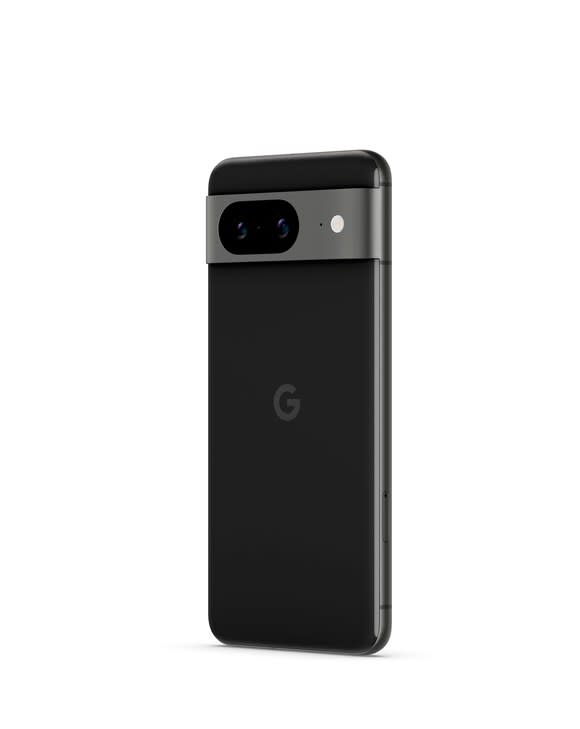


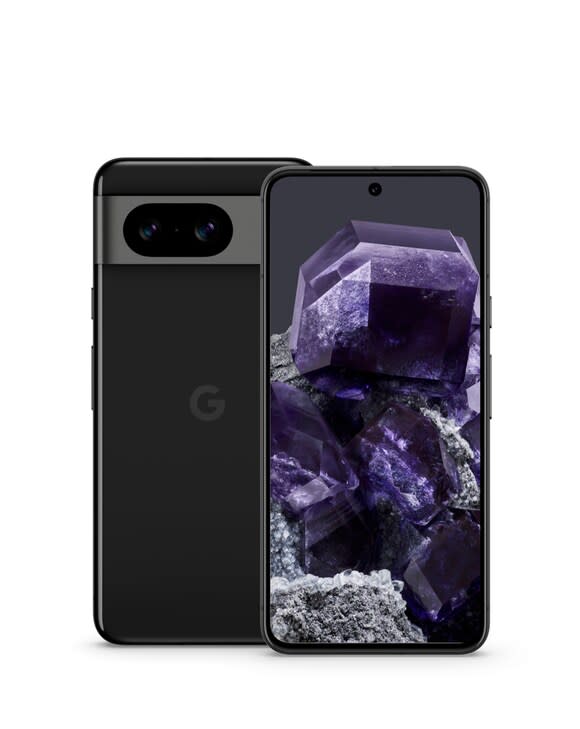
- Chipset
- Google Tensor G3
- Display
- 6.2-inch 120Hz OLED
- Main camera
- 50MP Main Camera with OIS
- Battery
- 4575 mAh Battery (27W Fast Charging)
Key features
- 5G: yes
- NFC: yes
- eSIM: yes
- Wi-Fi 6/7: yes
- IP68: yes
- Headphone jack: no
- Released
- October 12, 2023
- Updates
- 7 years of OS, security, and feature drop updates
- Colors
- Obsidian, Hazel, Rose, Mint
Google Pixel 8 overview
The Google Pixel 8 is a Google smartphone released in October 2023 with a US reference price of $699. It runs on the Google Tensor G3, has a 6.2-inch 120Hz OLED display, uses a 50MP Main Camera with OIS and packs a 4575 mAh battery. It supports 5G.
Compare before you buy

General
- Weight
- 187 g (6.60 oz)
- Dimensions
- 150.5 x 70.8 x 8.9 mm (5.93 x 2.79 x 0.35 in)
- Build
- Glass front (Gorilla Glass Victus), glass back (Gorilla Glass Victus), aluminum frame
- SIM
- Nano-SIM and eSIM
- Water resistance
- IP68 dust/water resistant (up to 1.5m for 30 mins)
- Variants
- 128GB 8GB RAM, 256GB 8GB RAM
Display
- Type
- OLED, HDR10+
- Size
- 6.2 inches, 91.1 cm2 (~85.5% screen-to-body ratio)
- Resolution
- 1080 x 2400 pixels, 20:9 ratio
- Refresh rate
- 120Hz
- Brightness
- 1400 nits (HBM), 2000 nits (peak)
- HDR
- HDR10+
- Protection
- Corning Gorilla Glass Victus
- Pixel density
- ~428 ppi
Performance
- Chipset
- Google Tensor G3
- CPU
- Nona-core (1x3.0 GHz Cortex-X3 & 4x2.45 GHz Cortex-A715 & 4x2.15 GHz Cortex-A510)
- GPU
- Immortalis-G715s MC10
- Process
- 4 nm
- RAM
- 8GB LPDDR5X
- Storage
- 128GB, 256GB
- Storage type
- UFS 3.1
- Geekbench (single / multi)
- 1700 / 4400
- Cooling
- Vapor Chamber
Rear camera
- Main
- 50 MP, f/1.68, 25mm (wide), 1/1.31", 1.2µm, dual pixel PDAF, multi-zone Laser AF, OIS
- Ultrawide
- 12 MP, f/2.2, 126˚
- Telephoto
- None
- Macro
- Dedicated Macro Focus (via Ultrawide AF)
- Stabilization
- OIS + EIS support on main camera
- Flash
- Dual-LED flash, Pixel Shift, Ultra-HDR, panorama
- Video
- 4K@24/30/60fps, 1080p@30/60/120/240fps; gyro-EIS, OIS, 10-bit HDR
Selfie camera
- Camera
- 10.5 MP, f/2.2, 20mm (ultrawide), 1/3.1", 1.22µm
- HDR
- Auto-HDR
- Portrait mode
- Portrait mode supported via AI
- Video
- 4K@24/30/60fps, 1080p@30/60fps
Battery & charging
- Capacity
- 4575 mAh
- Wired charging
- 27W wired, 18W wireless
- Wireless charging
- 18W wireless
- Reverse charging
- Reverse wireless charging
- Charger in box
- No, sold separately
- USB
- USB Type-C 3.2, OTG
Network & connectivity
- 5G
- Yes
- Wi-Fi
- Wi-Fi 802.11 a/b/g/n/ac/6e/7, tri-band, Wi-Fi Direct
- Bluetooth
- 5.3, A2DP, LE, aptX HD
- NFC
- Yes, supports contactless payments
- Positioning
- GPS (L1+L5), GLONASS (G1), GALILEO (E1+E5a), QZSS (L1+L5), NavIC
- IR blaster
- No
- Headphone jack
- No, uses USB-C or Bluetooth
Sensors
- Fingerprint
- Under display, optical
- Gyroscope
- Yes
- Compass
- Yes
- Accelerometer
- Yes
- Face unlock
- Yes
Software & AI
- OS
- Android 14
- Updates
- 7 years of OS, security, and feature drop updates
- AI features
- Best Take, Magic Editor, Audio Magic Eraser, Video Boost (cloud-based), Live Translate, Call Screen
- Circle to Search
- Yes
- AI photo editing
- Yes
- Live translation
- Yes
- AI assistant
- Yes
Disclaimer. We cannot guarantee that the information on this page is 100% correct. Read more
Pros and cons
Pros
- Shrinks down to an incredibly comfortable, highly pocketable 6.2-inch physical size.
- Introduced a spectacular 120Hz OLED screen (branded as Actua) to the standard model for the first time.
- Google promises 7 years of Android OS and security updates.
- The new Tensor G3 chip brought highly impressive new AI features like Magic Editor and Audio Magic Eraser.
Cons
- Despite the newer chip, thermal management and overall battery life remain highly frustrating and inconsistent.
- Suffered a noticeable base price increase compared to the excellent, highly aggressive value of the older Pixel 7.
- Still completely lacks a dedicated optical telephoto zoom lens, relying entirely on AI digital cropping.
- Many of the highly-advertised, complex AI features require a cloud connection rather than running entirely on-device.
Frequently asked questions
How much does the Google Pixel 8 cost in the US?
The Google Pixel 8 starts at $699 in the US for the 128GB model. It comes with 128GB and 256GB of storage; larger storage costs more.
When was the Google Pixel 8 released?
The Google Pixel 8 was released in October 2023.
How big is the Google Pixel 8?
The Google Pixel 8 measures 150.5 x 70.8 x 8.9 mm (5.93 x 2.79 x 0.35 in) and weighs 187 g (6.60 oz), with a 6.2 inches, 91.1 cm2 (~85.5% screen-to-body ratio).
What colors and storage options does the Google Pixel 8 come in?
The Google Pixel 8 comes in Obsidian, Hazel, Rose and Mint. Storage options: 128GB and 256GB.
Is the Pixel 8 smaller than the Pixel 7?
Yes! Google actively chose to shrink the Pixel 8 down to a much more comfortable 6.2-inch screen size, making it significantly easier to use one-handed than the older 6.3-inch Pixel 7.
Does the Pixel 8 have a 120Hz screen?
Yes! For the very first time, Google brought a buttery-smooth 120Hz OLED panel (branded heavily as the 'Actua' display) to the standard non-Pro Pixel.
How long will the Pixel 8 get updates?
Google fundamentally changed the smartphone industry by promising a massive 7 full years of major Android OS and security updates, officially keeping the phone relevant until 2030.
Does the Pixel 8 have a telephoto lens?
No. It still features a standard dual-camera setup (Main and Ultrawide) and entirely lacks a dedicated optical telephoto lens for high-quality zoom.
Does the Pixel 8 overheat?
Unfortunately, yes. While the Tensor G3 chip is definitely better than older generations, it still noticeably struggles with heat management and thermal throttling during intense gaming.